IHT pension rules explained: what changes in 2027 and what families should do now
IHT pension rules explained: what changes in 2027 and what families should do now
For years, pensions sat in a privileged corner of estate planning. Many defined contribution pension pots could pass on death without falling into the taxable estate for Inheritance Tax (IHT), provided the scheme trustees or administrator had discretion over who received the death benefits. Families got used to the idea that the house, savings and investments were the IHT problem, whilst the pension was the cleaner asset to leave until last.
That changes for deaths on or after 6 April 2027.
Under reforms now set out in legislation and HMRC technical material, most unused pension funds and pension death benefits will be brought into account for IHT. In practical terms, many estates that never had to think about pension death benefits for IHT will suddenly need to. Some will pay IHT for the first time. Others already facing an IHT bill will see it increase, sometimes sharply.
According to government estimates published alongside the reform, around 10,500 estates are expected to pay IHT for the first time, and 38,500 estates are expected to pay more. That is not every family. It is not even most families. But it is enough people that any decent estate plan now has to take pension wealth seriously.
The short answer
If you want the position in one plain statement: from 6 April 2027, most unused pension pots and many pension death benefits will count towards the value of your estate for IHT purposes.
The standard IHT rate remains 40%. The usual thresholds and exemptions still matter:
- the nil-rate band is £325,000
- the residence nil-rate band can add up to £175,000 if a qualifying home passes to direct descendants
- transfers to a spouse or civil partner are generally exempt
- gifts to qualifying charities are generally exempt
So the pension reform does not create a new tax. It changes what gets counted.
And that distinction matters. A couple whose combined estate is comfortably below the available thresholds may still have no IHT issue at all. A widowed parent with a £650,000 pension pot and a mortgage-free house may have a very different answer.
💡 Pro tip: Our app helps you store your pension details, will, insurance policies, property deeds, and key contacts in one secure place, ready for when your family needs them.
(FREE For Life – First 100 Signups only)
Download on Google Play Download on the App Store
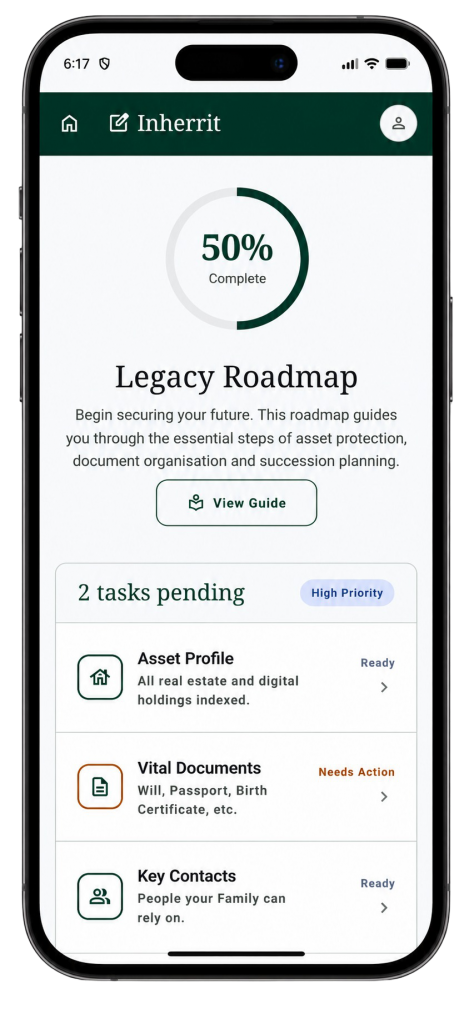
Download on Google Play Download on the App Store
What the position is before April 2027
Under the current rules, many pension death benefits sit outside the member’s estate for IHT because the trustees or scheme administrator normally decide who receives them. An expression of wishes form helps guide that decision, but it usually does not bind them. That trustee discretion has been the technical reason many pension pots have avoided IHT.
This has been especially valuable for defined contribution pensions: personal pensions, SIPPs and most modern workplace money purchase schemes. If the member died with funds still in the scheme, a beneficiary could often receive a lump sum or inherited drawdown fund without that pension itself swelling the member’s estate for IHT.
That treatment made pensions unusually attractive for wealth transfer. Plenty of clients drew from ISAs, general investments and even cash reserves before touching pension funds, because the pension was often the last asset you wanted to spend if your aim was to pass wealth efficiently.
There were always exceptions. Some older arrangements, certain annuity structures, retirement annuity contracts and Section 32 buy-out policies could have a different IHT outcome. Defined benefit arrangements also needed separate treatment because they do not work like a pot of money. But broadly, the old rule of thumb was simple enough: discretionary pension death benefits were often outside the estate.
What changes on 6 April 2027
For deaths on or after 6 April 2027, the law treats most pension wealth held immediately before death as part of the member’s estate for IHT. HMRC refers to this as notional pension property. The core legislation sits in the Inheritance Tax Act 1984, as amended by Finance Act 2026.
This means the old planning instinct of keeping money inside a pension because it is automatically outside the estate no longer works in the same way. Trustee discretion still matters for administration and timing. It no longer decides whether the pension is inside or outside the IHT calculation in most cases.
The value brought into account is generally the value of the unused pension fund immediately before death, subject to specific exclusions and exemptions. If that extra value pushes the estate above the available bands, IHT becomes payable. If the benefits go to an exempt beneficiary, such as a spouse or civil partner, the value may still be included in the reporting but relieved by exemption.
That last point catches people out. Included does not always mean taxed. But included does mean the figures need to be gathered, reported and analysed.
For the official position on thresholds and the current IHT framework, HMRC’s own guidance is here: https://www.gov.uk/inheritance-tax Inheritance Tax on GOV.UK.
Which pensions are most affected
The biggest practical change is for defined contribution pensions with money still sitting in them at death. That includes:
- personal pensions
- SIPPs
- stakeholder pensions
- most money purchase workplace schemes
- unused drawdown funds
- inherited drawdown funds still in the pension wrapper when the beneficiary dies
These are the arrangements most often used as estate planning vehicles over the last decade. They are also the arrangements most likely to create a genuine IHT surprise after April 2027.
Defined benefit schemes are affected differently. There is usually no individual investment pot to value in the same sense. Instead, the relevant amount may be a lump sum death benefit or certain continuing guaranteed payments. A surviving dependant’s scheme pension is treated differently again and is one of the important exclusions.
Annuities also need care. A joint life annuity paying continuing income to a survivor is not treated the same way as an annuity protection lump sum or guaranteed-period payment. The label on the paperwork matters less than the underlying legal structure.
And that is why generic online answers can do real damage here. “Pensions will be taxed from 2027” is too blunt to be useful.
What is excluded from the new IHT pension rules
Not every pension-related payment falls into the new IHT calculation. Some benefits are expressly excluded.
The main exclusions include:
- death-in-service benefits
- dependants’ scheme pensions
- certain joint life annuities and related survivors’ annuities
- certain trivial commutation payments replacing an otherwise excluded dependant’s pension
- certain non-UK pension situations where the deceased was not a long-term UK resident
Death-in-service benefits staying outside the charge is a sensible part of the reform. A lump sum linked to current employment has never really belonged in the same policy box as a retirement pot deliberately left untouched into later life.
Dependants’ scheme pensions are another major exclusion. In plain English, where a scheme pays a surviving spouse, civil partner, child or financially dependent person an income because of the member’s death, that pension income can be outside the IHT calculation even though other death benefits from the same overall pension landscape may not be.
This is particularly relevant in many defined benefit schemes. People hear “pension now pays IHT” and assume the widow’s or widower’s pension will be taxed as part of the deceased’s estate. Often, it will not.
What still stays exempt
The familiar IHT exemptions remain central.
Spouse and civil partner exemption
If pension death benefits pass to a surviving spouse or civil partner, the transfer is generally exempt from IHT, assuming the normal conditions are met. That means many married couples and civil partners still will not pay IHT on first death, even after 2027.
But there is a trap: exemption on first death does not remove the problem forever. It may simply defer it until the survivor dies. A couple with a £550,000 home, £150,000 in savings and investments, and £700,000 in combined pensions may have no IHT on first death if everything passes to the survivor. On second death, the combined value is now the real issue.
Charity exemption
Benefits passing to qualifying charities are generally exempt. In some estates, charitable legacies also help secure the reduced IHT rate of 36% instead of 40% where at least 10% of the relevant component of the estate passes to charity. Pension assets can matter in that calculation after 2027.
Nil-rate bands still apply
Everyone still has the ordinary nil-rate band of £325,000. Many estates can also claim the residence nil-rate band of up to £175,000 where a qualifying residence passes to direct descendants. Transferable allowances between spouses and civil partners still exist.
So, in broad terms, a married couple or civil partners may still be able to pass up to £1 million free of IHT on second death if they qualify for both nil-rate bands and neither allowance is tapered away.
But once the total estate exceeds £2 million, the residence nil-rate band starts to taper. Large pension pots can push an estate over that line quickly.
A pension nomination form still matters. Just not for the reason people think
One question I am hearing almost weekly now: if the pension will be taxed for IHT anyway, does the nomination or expression of wishes form still matter?
Yes. Absolutely.
It matters because the form still guides the scheme trustees or administrator on who should receive the death benefits. That is critical for family outcomes, speed of payment and, in some cases, whether a spouse exemption or charity exemption applies in practice. If your form still names an ex-spouse, or only one child from a previous relationship, or your “current partner” from 2016, the tax point is not your only problem.
What the nomination form does not usually do after 2027 is keep the pension outside your estate for IHT merely because the scheme retains discretion. That old advantage largely goes.
So people should stop asking, “Can the form save IHT?” and start asking, “Does the form still direct the pension to the right people, in the right shares, with the right flexibility?”
For blended families this is vital. A member might want 50% to a second spouse and 25% each to children from a first marriage. Or they may want an adult child’s share considered for a discretionary trust because of addiction, divorce risk or means-tested benefits. The nomination cannot do every job on its own, but failing to update it is still one of the most expensive unforced errors in estate planning.
Should you put your pension in your Will?
Usually, no.
A Will and a pension sit in different legal systems. Your Will deals with assets in your estate. Pension death benefits are usually dealt with under the scheme rules and trustee or administrator discretion. The new IHT rules do not mean pensions should suddenly be written into Wills as if they were bank accounts.
Trying to force pension benefits through the Will can create confusion rather than control. It may also cut across the scheme’s own procedures. The better approach is usually this:
- make sure your Will deals properly with your estate assets
- make sure your pension nominations are current and consistent with that plan
- make sure your advisers have looked at both together
That joined-up review is what has often been missing. A beautifully drafted Will and a 12-year-old pension nomination form are not a plan. They are two documents heading in different directions.
The income tax point does not disappear
People focus on IHT because the reform is about IHT. Fair enough. But beneficiaries may also face income tax on pension death benefits, and the interaction can be painful.
The broad rule remains familiar:
- if the member dies before age 75, many defined contribution death benefits can usually be taken by beneficiaries free of income tax, subject to the detailed rules
- if the member dies aged 75 or over, beneficiaries usually pay income tax at their marginal rate when they draw funds
So after April 2027, some beneficiaries will face a double layer: IHT first, then income tax on what they draw.
That sounds brutal, and it can be. Take a £500,000 inherited pension fund from someone who dies after age 75, where the beneficiary is an adult child and the estate has no available nil-rate band left. If £200,000 of IHT is effectively attributed to that fund, and the child later draws the balance whilst already a higher-rate taxpayer, the total tax drag can be severe.
There is, however, an important relieving feature. Where IHT has been paid in relation to inherited pension wealth, the legislation aims to prevent income tax applying to the same slice again in full. In broad terms, the beneficiary’s taxable pension income can be reduced to reflect the burden of IHT suffered. The mechanics will matter, and the route used to pay the IHT matters too, but the policy intent is to avoid crude double taxation on the same pounds.
Still, the family cashflow impact can be ugly. That is why “leave the pension to the children, it’s tax free” is now dead advice.
A side-by-side comparison of common pension death benefits
The easiest way to understand an IHT pension issue is often to compare the arrangements directly.
Defined contribution pension pot
Before 6 April 2027, an unused defined contribution pot was often outside the estate for IHT where trustees or administrators had discretion. After 6 April 2027, most unused funds are brought into the estate for IHT.
If the beneficiary is a spouse or civil partner, exemption may prevent tax on that transfer. If the beneficiary is an adult child, cohabiting partner or other non-exempt person, the pension may increase the IHT bill. Income tax then depends largely on whether the member died before or after 75.
Beneficiary drawdown
Before 2027, inherited drawdown could be very efficient because the pension stayed outside the beneficiary’s estate in many cases and outside the original member’s estate for IHT. After 2027, the value remaining in the member’s pot at death is generally still counted for the member’s IHT, even if paid into beneficiary drawdown.
That means inherited drawdown can still be useful. It may still keep assets outside the beneficiary’s own estate while they are left in the pension wrapper. But it no longer cleanses the original death of IHT.
Defined benefit scheme lump sum
If a defined benefit scheme pays a lump sum death benefit, that may be within the new rules unless an exclusion applies. The scheme’s terms are crucial. Not every DB death benefit is treated the same way.
Dependants’ scheme pension
A continuing pension paid to a dependant after the member’s death is generally an excluded benefit for IHT. That exclusion makes many spouse’s pensions under occupational schemes far less problematic than clients fear when they first read the headlines.
Joint life annuity
A survivor’s income under a joint life annuity is generally excluded. Again, the continuing pension income can sit outside the IHT issue even whilst other unused pension assets do not.
Death-in-service benefit
This remains excluded. If an employee dies whilst still in service and a registered death-in-service scheme pays a lump sum, that payment should remain outside the IHT pension charge, even after 2027.
Worked example: married couple, adult children
Take Daniel and Priya, both widowed once before meeting and now married. Daniel dies in May 2028 aged 78. He leaves:
- half share of the family home: £250,000
- ISA portfolio: £180,000
- cash and premium bonds: £40,000
- personal possessions: £30,000
- unused defined contribution pension: £620,000
His Will leaves everything to Priya. His pension nomination also names Priya.
On Daniel’s death, there is normally no IHT because the assets and pension death benefits passing to Priya are covered by the spouse exemption. So far, so straightforward.
Priya then dies in 2031. Her estate consists of:
- whole house: £500,000
- investments and cash: £320,000
- her own pension: £260,000
- inherited pension fund from Daniel, now worth: £540,000
- personal possessions: £20,000
Total value: £1,640,000.
Assume both nil-rate bands and both residence nil-rate bands are available, giving a total combined threshold of £1,000,000. The taxable estate is then £640,000, producing IHT at 40% of £256,000.
Before the pension reform, much of the inherited and retained pension value might not have fed into that IHT calculation. After April 2027, it does.
The tax was not created by Daniel’s death. It was delayed by it.
Worked example: unmarried couple living together
This is where the new rules can bite very hard.
Take Mark and Eleanor, unmarried, both in their sixties, living together in a house owned solely by Mark. He dies in July 2028. His assets are:
- house: £650,000
- savings and investments: £140,000
- car and possessions: £10,000
- SIPP: £500,000
He leaves everything to Eleanor. His pension nomination also names Eleanor.
Total value for IHT purposes after 6 April 2027: £1,300,000.
Available nil-rate band: £325,000.
Residence nil-rate band? Possibly not available if the home is not passing to direct descendants.
Spouse exemption? No, because they were not married and not in a civil partnership.
That leaves £975,000 exposed to IHT. At 40%, the tax bill is £390,000.
Could planning have changed that? Quite possibly. Marriage or civil partnership would have changed the answer dramatically. So would lifetime planning. So would restructuring ownership of the home and reviewing withdrawal and gifting strategy several years earlier.
Cohabiting couples are the group most likely to discover that the law does not treat them as spouses, no matter how long they have lived together. Estate planning has always been harsher on unmarried couples. The pension reforms make that even more obvious.
Blended families, stepchildren and vulnerable beneficiaries
The tax rules are one problem. Family dynamics are usually the bigger one.
A surviving spouse or civil partner can receive pension death benefits free of IHT by exemption, but that may store up a later tax charge and also disinherit children from a first relationship if the survivor changes their Will or nomination later. Some clients are entirely relaxed about that risk. Others are not. Both positions are respectable. Pretending the risk does not exist is not.
Stepchildren add another wrinkle. For the residence nil-rate band, stepchildren count as direct descendants. That can help. But pension death benefits do not automatically follow the same emotional logic as the family home. If your nomination form names only your spouse and says nothing about the children of either relationship, the trustees may still follow it.
For a vulnerable beneficiary, inherited drawdown can still be useful from an asset-protection perspective, but it is not a cure-all. A person with addiction issues, severe debt, a chaotic marriage or means-tested benefits may be the worst possible recipient of a large lump sum or unrestricted drawdown fund. In those cases, trust planning may still deserve attention, even though the IHT treatment has changed.
Trusts and pension planning after 2027
Trusts are where pension conversations can slide into jargon very quickly. So keep it simple.
Historically, some people used bypass trusts so that pension lump sums could be paid on death into a discretionary trust rather than directly to a spouse or children. The trust could then lend money to the survivor, control access, and keep growth outside the survivor’s estate. In the old world, that often had genuine IHT planning logic.
After 6 April 2027, a bypass trust no longer performs the same magic trick for unused defined contribution funds because the pension can already be brought into account for the deceased member’s IHT before the trust even receives it. So the trust may still help with control, protection, second-marriage risk, and vulnerable beneficiaries. It is often weaker as a pure IHT shelter.
That does not make trusts pointless. It makes them more honest. You use them because you need governance, not because you have heard that “pensions in trust avoid tax”.
A discretionary trust may still be helpful where the family wants trustees to decide timing and amount of distributions. A disabled person’s trust or other specialist structure may still be appropriate in the right case. But every trust used in this area now needs to justify itself on present facts, not on pre-2027 folklore.
The Trustee Act 1925 still matters because trustees need to understand their powers, duties and investment obligations if a trust is going to receive or manage death benefits or related assets. Badly run trusts are not sophisticated. They are just expensive.
Should you withdraw pension money before 2027?
Sometimes yes. Sometimes no. Anyone promising one universal answer is overselling.
For some clients, especially those with large defined contribution pots they do not need for retirement spending, drawing funds before death and making lifetime gifts can reduce the eventual IHT problem. That may mean:
- taking the 25% tax-free lump sum if still available
- taking taxable withdrawals and accepting income tax now to reduce IHT later
- gifting cash to children, grandchildren or a trust
- using withdrawals to fund life insurance premiums written in trust
But there is a cost. Pension withdrawals above the tax-free element can trigger income tax at 20%, 40% or 45%. Pulling large sums out casually can wreck the tax efficiency you were trying to preserve.
A simple comparison helps. Suppose Helen, age 74, has a £900,000 SIPP she does not need for income, plus other assets already using her available nil-rate band. If she leaves the pension untouched and dies after 6 April 2027, the full £900,000 may be inside the IHT calculation. If she instead withdraws £225,000 tax free and gifts it, surviving seven years, that £225,000 can be outside her estate with no income tax cost on the extraction.
Should she then withdraw the rest? Maybe. But if she pulls another £300,000 in one tax year, the income tax cost may be substantial. A phased approach over several tax years might work better. Or it might not, if health is failing and time is short.
This is why pension planning now often becomes a cashflow and modelling exercise, not just a tax discussion.
Gifts out of surplus income: useful, but easy to get wrong
The exemption for normal expenditure out of income is one of the best IHT reliefs in the system and one of the most badly evidenced.
If you make regular gifts out of surplus income, and those gifts do not reduce your standard of living, they can be exempt from IHT immediately. No seven-year wait. No taper. Just exempt, if the facts support it.
Can pension withdrawals fund those gifts? Sometimes. But HMRC will not simply accept the label you put on the transaction. A one-off withdrawal from drawdown specifically made to hand £40,000 to a child may look more like capital than income. An annuity paying regular monthly income is far easier to characterise as income.
The exemption has three core requirements:
- the gifts must form part of your normal expenditure
- they must be made out of income, not capital
- after making them, you must be left with enough income to maintain your usual standard of living
Executors often struggle to prove this after death because the deceased left no records. If you want to use the exemption properly, keep:
- annual income schedules
- bank statements showing the pattern of gifts
- a note explaining the intention to make regular gifts
- a summary of living costs showing there was genuine surplus income
- copies of pension statements, annuity schedules and tax returns where relevant
Frankly, this is an area where a modest bit of paperwork saves a very large argument later.
A practical habit helps: review the pattern each tax year and keep a dated note. Digital storage tools can help here. If you keep pension statements, gifting records, beneficiary details and notes of intention in one secure place, your executors are in a much stronger position. Platforms such as Inherrit can be useful for this kind of practical organisation because they give families one encrypted place to store pension details, advisers’ contact information, wills and evidence of gifts rather than leaving executors to hunt through drawers and old emails.
The seven-year rule still matters
Most outright lifetime gifts remain potentially exempt transfers. If you survive seven years, they fall outside the estate. Die earlier, and some or all of the value can come back into account.
This is not new. The pension reforms simply mean more people are now considering gifts funded by pension withdrawals.
Taper relief is often misunderstood. It does not reduce the value of the gift. It can reduce the tax on the gift if death occurs more than three years later, but only where tax is actually payable on that gift after using available nil-rate band.
💡 Pro tip: You’ve read about iht pension. Now take the next step — our app helps you store your will, insurance policies, property deeds, and key contacts in one secure place, ready for when your family needs them.